The Sword Guard

Tsuba

The guard as an object of study: its purpose and constraints, its anatomy, the metals it was made from, and the motifs worked into its surface.

鐔の役割

A Guard That Had to Work

A tsuba sits between the grip and the blade. Its first duty was plain: to keep the hand from sliding forward onto the edge, and to stop a blade from running down onto the fingers. Unlike the guards of most European swords, which are joined to the hilt, the Japanese guard is a separate plate that slides over the tang and is held only by the fittings around it.

From the Edo period the guard became a surface for metalwork as well as a defence, and the best of them were made to be looked at as much as carried. Even so, the working constraints held. A guard had to be strong enough to stop a blow, heavy enough to balance the sword but light enough to swing, and small enough to sit at the waist without catching. The seppadai — the seating around the tang slot — was kept free of carving and of any decoration that would prevent the spacers from bedding down.

Those limits are what make tsuba legible as a form: an object with a small, strictly defined working area, in which generations of smiths worked out an enormous range of solutions in iron and soft metal.

鐔の構造

Tsuba Anatomy

The parts of a tsuba carry their own vocabulary, and most of it concerns the openings cut for the accessories worn with the sword. Select a numbered marker on the guard, or a term beside it, to read about that part.

Iron tsuba · select a number

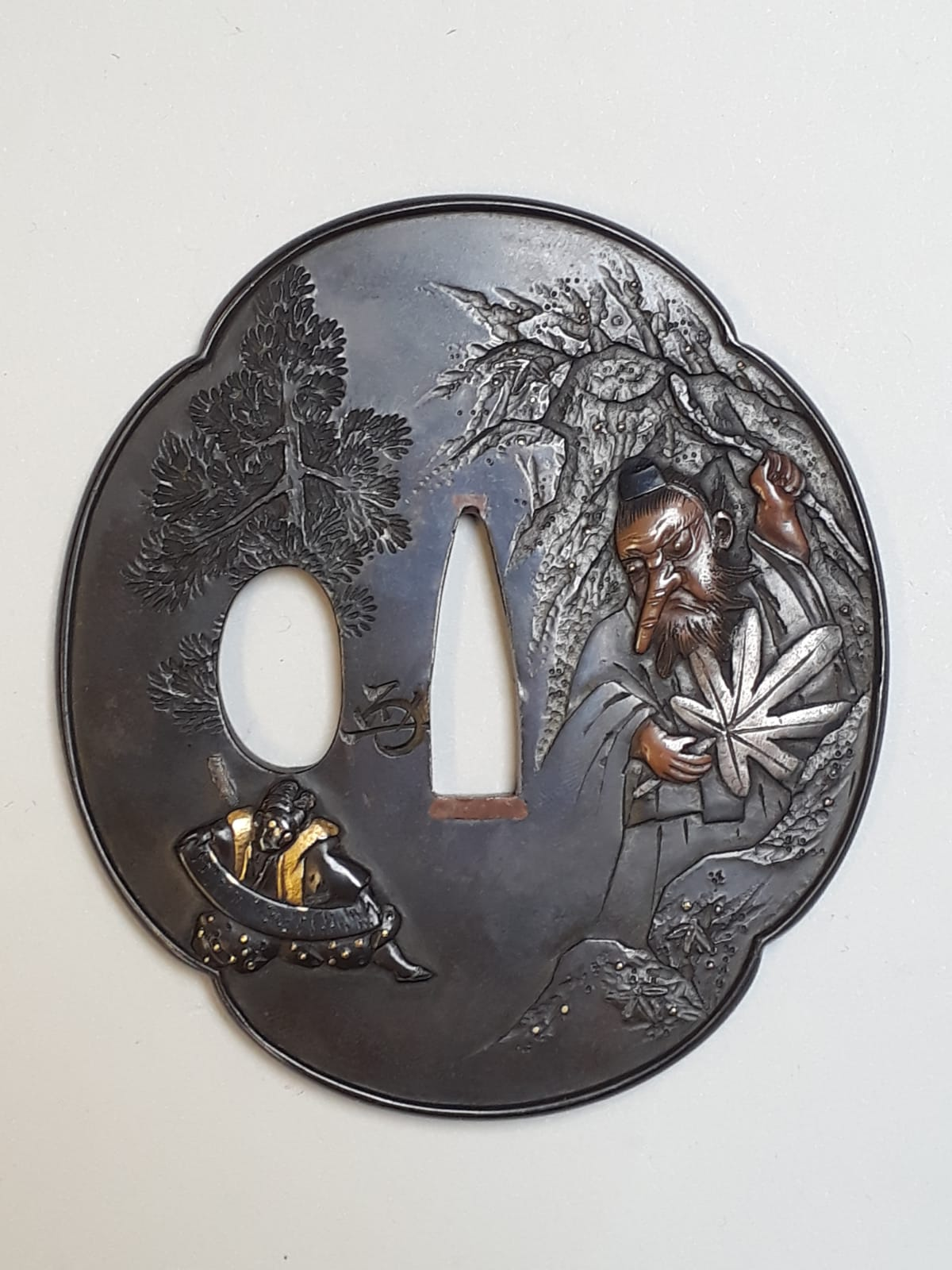
Photograph of an iron tsuba, numbered by part

Iron guard · five parts marked

Select a number to read about that part. Parts this guard does not carry are listed without a number.

1

耳

Mimi

Rim

Marked on this guard

The rim — the outer edge of the plate, read as closely as the design itself. It may be left plain, raised into a dote-mimi ridge, turned back, or carved so the design runs around the edge, and its treatment is a reliable marker of school.

On this photograph

On this guard the rim is a narrow, softly rounded edge that follows the outline without breaking into the carving.

形

Shape

Outline is the first thing a collector reads. The round form, maru-gata, is the most common; the four-lobed mokkō-gata, recalling a melon or a leaf, is nearly as widespread and appears from the Heian period onward. Squared guards (kaku-gata), tall ovals (tate-maru-gata), and guards cut to the outline of a crest or a flower — the aoi-gata of the hollyhock and the kiku-gata of the chrysanthemum — all occur. Pierced guards (sukashi) extend the shape inward: the design itself becomes the opening, and the plate becomes a silhouette.

A guard may also be ita — a solid plate, usually of iron, with no piercings at all — and this plainness is a style in its own right, particularly among the early iron schools.

素材

Metals

Most surviving guards are iron, or copper alloys, or a combination of the two. The alloy and its treatment decide the colour of the ground, and colour is a large part of what is admired.

鉄

Tetsu · Iron

The dominant material for fighting guards: tough, resilient, and capable of the deep rust-brown patina prized by collectors. Elaborate iron work was especially fashionable in the Bakumatsu years.

素銅

Suaka · Pure copper

Refined copper, softer and purer than yamagane. Polished it shows a warm reddish tone, which earned it the name akagane ("red metal").

赤銅

Shakudō · Copper–gold alloy

Copper with a small percentage of gold, taking a near-black surface — likened to a crow, hence karasu. Prized for its workability and its deep colour, but it is attacked by acid, so bare fingers should be kept off it.

山銅

Yamagane · Unrefined copper

Copper left with its natural impurities, giving a yellowish-brown tone that may run bluish-black. Its plain, soft texture kept it in use long after refining improved.

四分一

Shibuichi · Copper–silver alloy

Roughly three parts copper to one of silver — shibuichi means "one quarter". Treated, it takes a fine silver-grey, hence its other name oborogin, "hazy silver".

朧銀

Oborogin · Hazy silver

The name given to shibuichi when its surface has been brought up to a soft, misted grey rather than a bright polish.

金

Kin · Gold

Reserved for the finest work: resistant to corrosion and brilliant in a way no alloy imitates. Often used as inlay or overlay on a base of iron or shakudō.

真鍮

Shinchū · Brass

A luxury material in period terms, and softer than iron. Brass guards were largely made to be looked at rather than fought behind.

Leather and horn were also used. They are weaker than iron and were never intended for the field, but they offered textures and colours that metal could not, and were prized for exactly that.

文様

The Motif Repertoire

Motifs were chosen, not merely copied. A design could declare a family allegiance, invoke a blessing, mark a season, or carry a private joke — and the same motif could be cut as openwork in iron or raised in gold on shakudō.

Nature

Sansui-zu

山水図

Landscape · Nature

Mountain-and-water scenery, a theme carried from Chinese landscape painting and established in Japan from the Kamakura period. Ranges, waterfalls, river bends and occasional figures are cut or carved into the plate, sometimes illustrating a legend rather than a real view.

Nami

波

Waves · Nature

Endless movement made waves a figure of eternity, endurance and renewal; the geometric Seigaiha pattern repeats the same idea. The design was thought fitting for a man’s dress and, by extension, for the sword he carried.

Fune

船

Ships · Nature

Boats appear alone, among waves, or as the treasure ship (takarabune) of the Seven Lucky Gods. From the Momoyama period, foreign trading vessels — nanban-sen — were also taken up, carrying the glamour of the unfamiliar.

Suisha

水車

Waterwheel · Nature

A familiar piece of rural machinery turned into ornament. In one variant the ladles become hammers (tsuchi-guruma), a visual pun on utsu, "to strike" — and so on striking an enemy.

Yukiwa

雪輪

Snow ring · Nature

Snowflake roundels, read as an omen of a plentiful harvest when snow fell at the New Year. The crystal motif appears from the Muromachi period and entered heraldry in the Edo period; Date Masamune counted a snow-ring crest among his.

Kumo

雲

Clouds · Nature

Cloud bands frame dragons and deities, and stand alone as an auspicious sign of good fortune descending. Their curves also serve as openwork, letting the guard stay light without losing strength.

Tsuki

月

Moon · Nature

Full, half, crescent or hazed, the moon is both an object of veneration and a symbol of authority. Because it waxes, it came to mean growth and promise; paired with rabbits, deer or autumn grasses it marks the season.

Auspicious

Ōgi

扇

Folding fan · Auspicious

The fan widens toward its edge — suehirogari, "spreading out" — and so figures an opening future and increasing prosperity. Once an elegant accomplishment of the Heian court, it also carried connotations of wealth and rank.

Ya

矢

Arrow · Auspicious

The arrow is a weapon and a talisman at once: the hama-ya is still sold to drive evil from a house. Variants include the fletching alone (yabane) and the whistling kabura-ya, once shot as a signal to open a battle and still heard in yabusame.

Takaradokushi

宝尽くし

Assembled treasures · Auspicious

A gathering of lucky objects, each with its own meaning: the invisibility straw coat and hat (protection), chōji blossom (health and a happy marriage), the lucky mallet (wishes granted), the scroll (wisdom), the gunbai fan (victory) and the fundō weight (wealth).

Heraldry

Tomoe

巴

Comma swirl · Heraldry

Comma-shaped forms, explained variously as magatama beads, swirling water, or the leather tomo worn at the wrist in archery. Read as water, the pattern became a charm against fire; as two or three commas (futatsu- and mitsu-tomoe) it became one of the commonest crests in Japan.

Kamon

家紋

Family crest · Heraldry

A family’s crest rendered in metal. On a sword mounting the crest announced whose sword it was, and a guard could be ordered to carry a daimyō house’s device as a mark of service as much as of ownership.

The catalogue above follows the sequence of designs set out in the Samurai Museum's Tsuba Archives, which also treats animals and plants in separate episodes. Those groups are covered more broadly on the mountings page.

流派と鑑定

Schools, Papers and Condition

Guards are attributed to schools and to individual makers. The major traditions include the Gotō family, whose soft-metal work set a standard for the whole Edo period; the Myōchin school of armourers and ironworkers; the Owari and Akasaka schools, known for bold pierced iron; the Higo group, whose restrained ironwork is much imitated; and Namban guards, made under European and Chinese influence.

Signatures (mei) occur, but on iron guards they are read with caution — many are later additions. Serious pieces may carry NBTHK or NTHK papers, exactly as blades do, and papers are the usual way an attribution is made legible to a buyer.

Condition matters in a particular way for fittings. The surface is the work. Patina should be undisturbed; the ground should not have been polished bright, and shakudō in particular should not be handled with bare fingers, since the acid in skin attacks it. A guard that has been aggressively cleaned has usually lost value rather than gained it.

参考

Sources

Educational Disclaimer

This page is a study reference for the history and terminology of Japanese sword guards. It is not a price guide, an authentication service, or instruction in metalwork. Attribution and valuation require examination of the object itself by a qualified specialist.
Scroll